# 基准测试
> pgvecto.rs 从诞生之初就专注于性能。我们持续监控 pgvecto.rs 的性能表现,并与其他向量检索库进行对比。
---
LLMS 索引: [llms.txt](/zh/llms.txt)
---
`pgvecto.rs` 从诞生之初就高度专注于性能。我们持续监控 `pgvecto.rs` 的性能表现,并与其他向量检索库进行对比测试。以下基准测试结果来自 2024 年 1 月。
测试在 Google Cloud [n2-standard-8](https://cloud.google.com/compute/docs/general-purpose-machines#n2_series)(8 vCPU,32 GB 内存)实例上进行,使用 `laion-768-5m-ip` 数据集。
## `pgvecto.rs` 对比 `pgvector` {#pgvecto-rs-vs-pgvector}
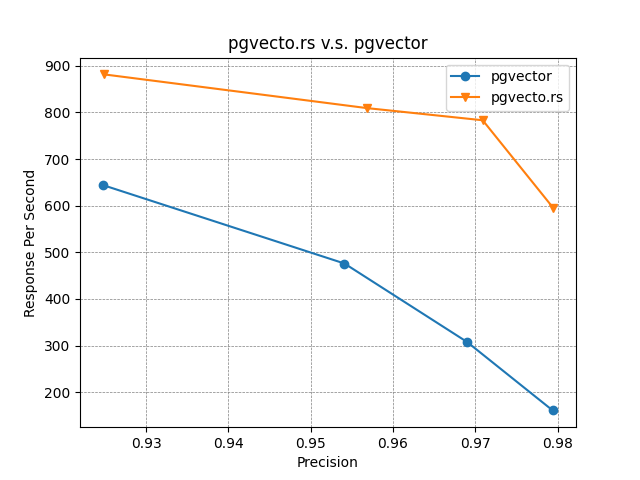
在使用 HNSW 索引时,`pgvecto.rs` 在保持约 97% 略高召回精度的同时,每秒响应数(RPS)可达到 `pgvector` 的 **2.5 倍**。当对召回精度要求更高时,这一性能优势还会进一步扩大。
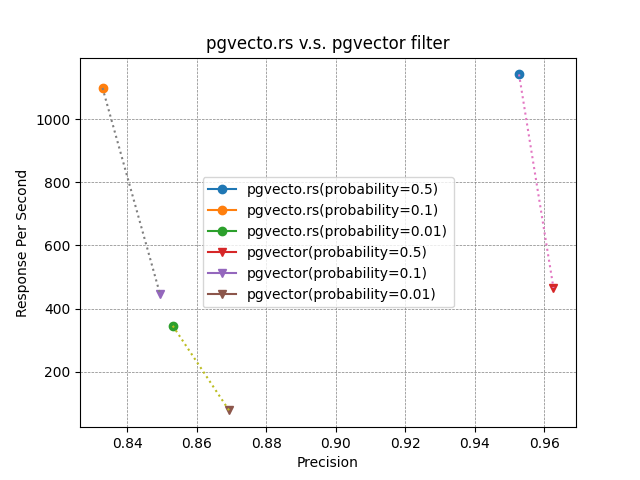
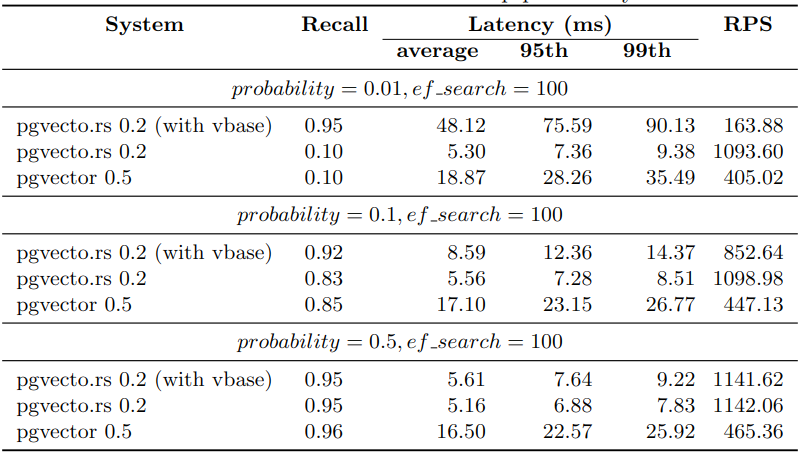
启用 `vbase` 模式后,在不同的过滤条件选择率(filter probability)下,`pgvecto.rs` 的每秒响应数相比 `pgvector` 均可提升 **2 倍以上**。
## 不同量化方法的对比 {#different-quantization-methods}
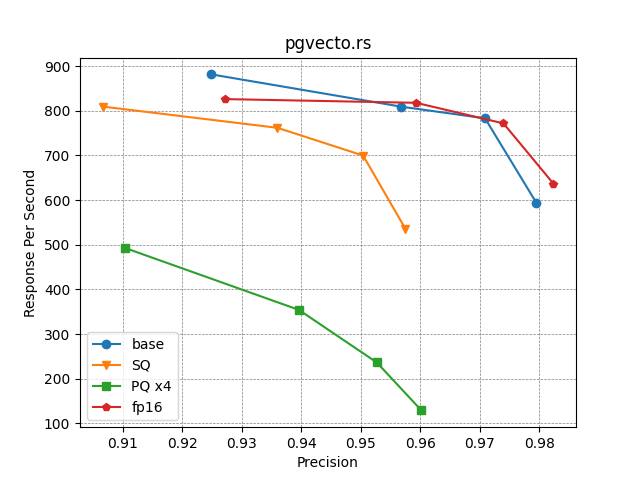
`pgvecto.rs` 支持多种[量化方法](/zh/pgvecto-rs/usage/quantization/)以及不同低精度的[索引方式](/zh/pgvecto-rs/usage/indexing/)。这些方法有助于在不同数据规模下大幅降低内存占用。下图展示了 `pgvecto.rs` 在不同量化方法下的性能表现:
## 缩短嵌入向量(即 [Matryoshka Embedding](https://aniketrege.github.io/blog/2024/mrl/)) {#shortening-embeddings-aka-matryoshka-embedding}
OpenAI 的[最新嵌入模型](https://openai.com/blog/new-embedding-models-and-api-updates)支持缩短嵌入向量(Shortening Embeddings),开发者只需“直接移除序列末尾的部分数值”,即可在更短的维度下依然保留有效的文本语义表征。
> 这一特性带来了极高的使用灵活性。例如,当使用的向量数据存储仅支持最高 1024 维的嵌入向量时,开发者依然可以使用我们最强大的嵌入模型 `text-embedding-3-large`,并将 API 参数 `dimensions` 指定为 1024,从而将嵌入向量从 3072 维缩短为 1024 维,以极小的精度折衷换取更紧凑的向量体积。
以下是针对缩短后嵌入向量的性能基准测试。测试采用 [dbpedia-entities-openai3-text-embedding-3-large-3072-1M](https://huggingface.co/datasets/Qdrant/dbpedia-entities-openai3-text-embedding-3-large-3072-1M) 数据集。原始嵌入向量为 3072 维,缩短后的嵌入向量分别为 256 维和 1024 维。基准测试同样在 Google Cloud 的 `n2-standard-8`(8 vCPU,32 GB 内存)虚拟机上进行。
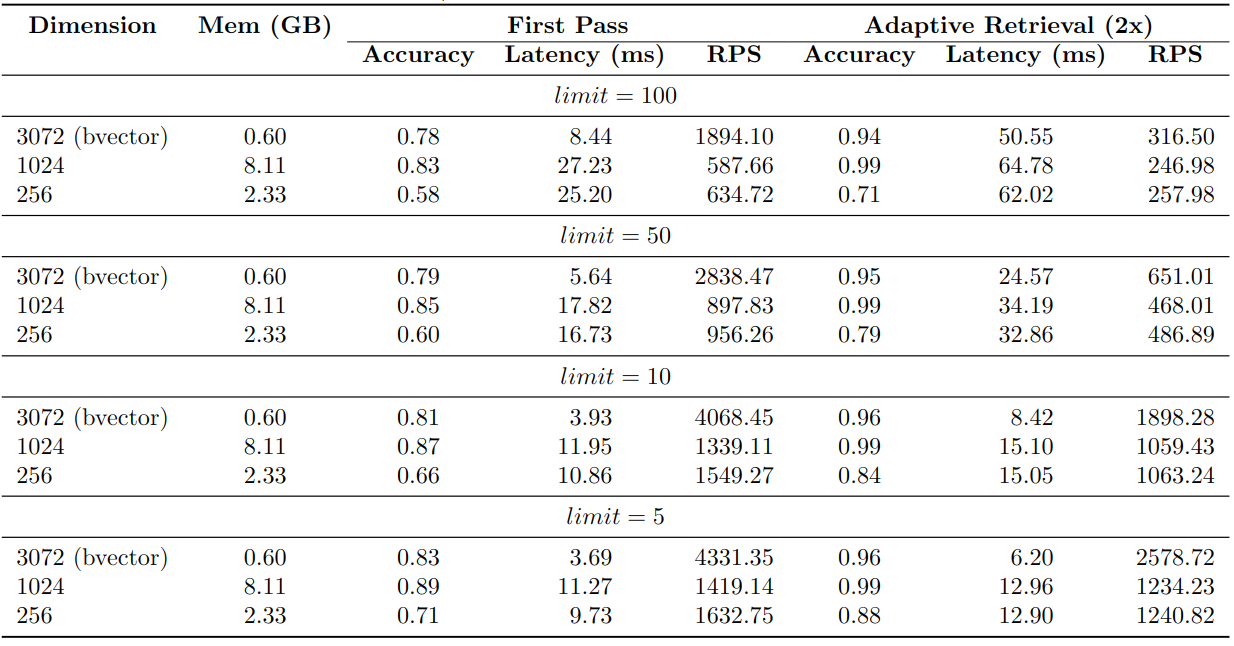
基准测试中的 **First Pass(初筛阶段)** 表明,仅使用缩短后的嵌入向量时,其召回精度不如完整维度的嵌入向量:256 维 HNSW 索引仅能达到约 65% 的准确率,而 1024 维 HNSW 索引约为 85%。
然而,当结合使用[自适应检索(Adaptive Retrieval)](/zh/pgvecto-rs/use-case/adaptive-retrieval/)时,缩短后嵌入向量的最终准确率能够超过 95%。此外,采用这种方法还能在 RPS(每秒请求数)和查询延迟方面带来显著提升。
## 二值向量 {#binary-vectors}
`pgvecto.rs` 支持[二值向量(Binary Vectors)](/zh/pgvecto-rs/reference/vector-types/bvector/)。`bvector` 类型专为存储效率与计算性能而优化,采用按位紧凑打包(bit-packed)的方式存储二值向量,并针对二值向量的距离计算进行了专门优化。
以下是 `bvector` 类型的性能基准测试,使用 [dbpedia-entities-openai3-text-embedding-3-large-3072-1M](https://huggingface.co/datasets/Qdrant/dbpedia-entities-openai3-text-embedding-3-large-3072-1M) 数据集,测试环境为 Google Cloud 上的 `n2-standard-8`(8 vCPU,32 GB 内存)虚拟机。
我们将 100 万条二值向量写入表中并建立索引,随后对每条查询向量运行 KNN 搜索。为 100 万条二值向量建立索引仅需约 600 MB 内存,而使用普通 `vector` 类型为相同数量的向量建立索引则需要约 18 GB 内存。
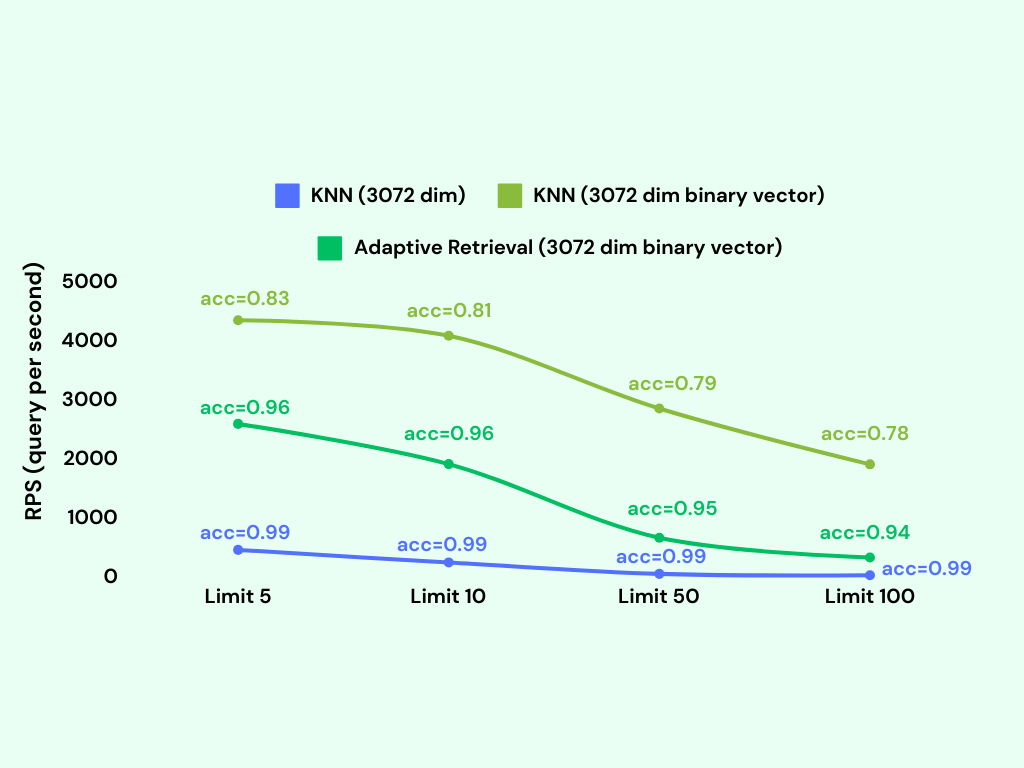
可以看到,单纯使用 `bvector` 的召回精度略低于 `vector` 类型,但如果结合采用[自适应检索(Adaptive Retrieval)](/zh/pgvecto-rs/use-case/adaptive-retrieval/),其准确率同样能够超过 95%。