This is the multi-page printable view of this section. .
FAQs
1 - General FAQ
We strongly suggest you explore our new VectorChord implementation, offering enhanced stability and performance. Users are advised to transition to VectorChord. Refer to the migration guide for assistance.
The vector type or operator class is not found
In most cases, this is due to a missing schema search path or a lack of permissions.
Please go through this checklist:
- Run
\dxwithpsqlorSELECT * FROM pg_extension;and check if the extension exists.
If not, install it with CREATE EXTENSION vectors;
- Run
SHOW search_path;and check if it containsvectors.
If not, set it with SET search_path="$user", public, vectors;
- If
pgvecto.rsis installed by another superuser
Run \dn with psql or SELECT nspname FROM pg_catalog.pg_namespace; and check if the schema vectors exists.
If not, log in as the superuser and grant schema permissions to current_user:
GRANT ALL ON SCHEMA vectors to tensorchord;
2 - Comparison with pgvector
Original post: pgvector vs. pgvecto.rs in 2024: A Comprehensive Comparison for Vector Search in PostgreSQL
TL; DR: Please navigate directly to the final section that contains a table showcasing the main distinctions.
Search
Search is essential for a database. It plays a pivotal role in facilitating efficient data retrieval, enabling users to quickly find and access the information they need. We will demonstrate their performance and highlight the various features pgvecto.rs and pgvector offer.
Filtering
While both pgvector and pgvecto.rs provide support for vector similarity search in PostgreSQL, pgvecto.rs goes a step further by introducing VBASE method from OSDI 2023.
Real-world workloads often involve a combination of vector search and relational queries. While vector search is powerful for similarity matching and retrieval of similar vectors, relational queries allow you to perform complex joins, filters, and aggregations on structured data.
pgvecto.rs is designed to perform efficiently in scenarios that involve Single-Vector TopK + Filter + Join.
We utilize the laion-768-5m-ip-probability dataset for benchmarking purposes due to the absence of a comprehensive relational benchmark. The dataset is derived from LAION 2B images. It contains 5,000,000 vectors, 10,000 queries.
The dataset includes a probability column that stores random floating-point values generated from a uniform distribution between 0 and 1. The ratio of 0.01 means that each query covers 1% (or 0.01 times) of the dataset, allowing for focused analysis.
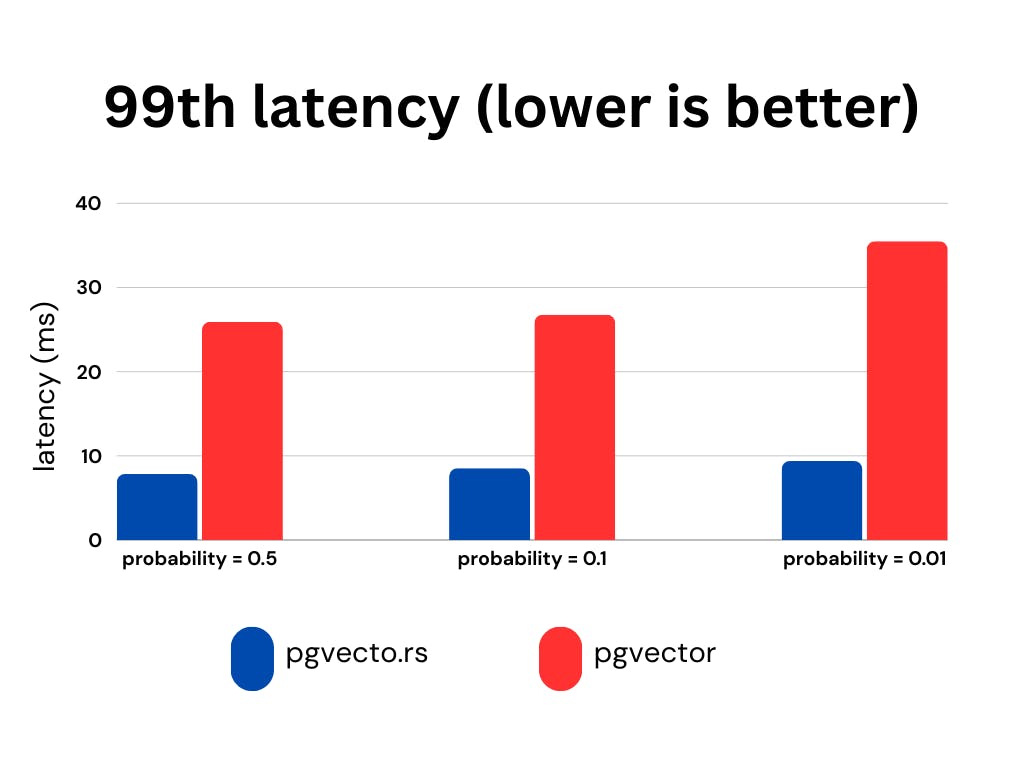
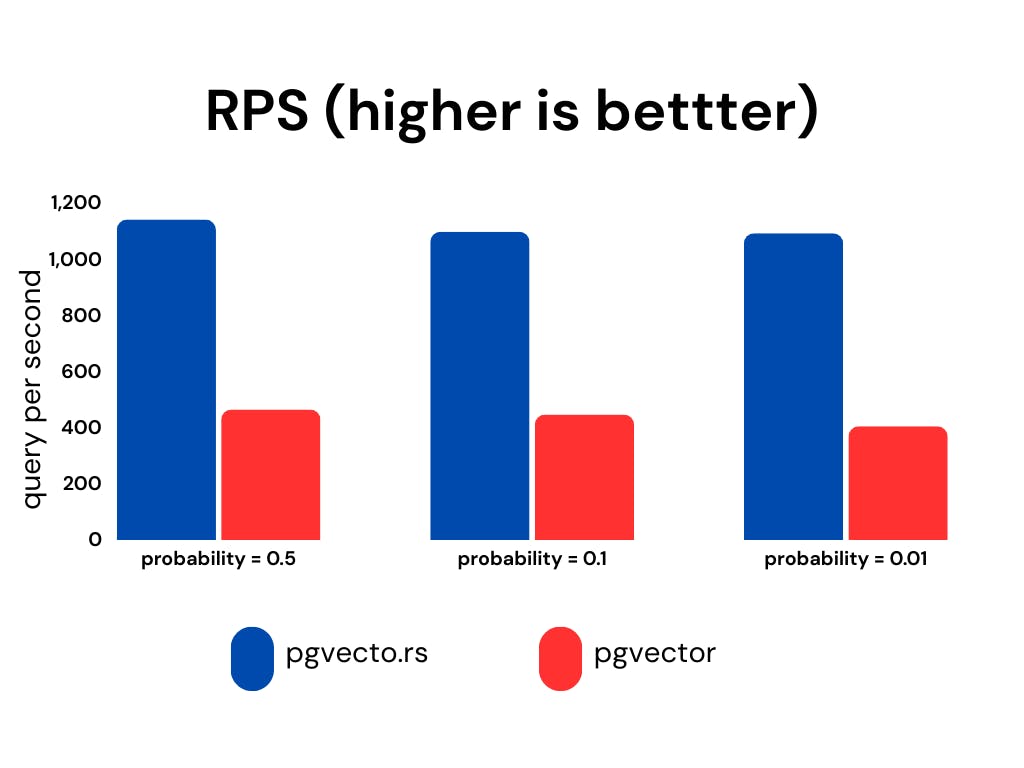
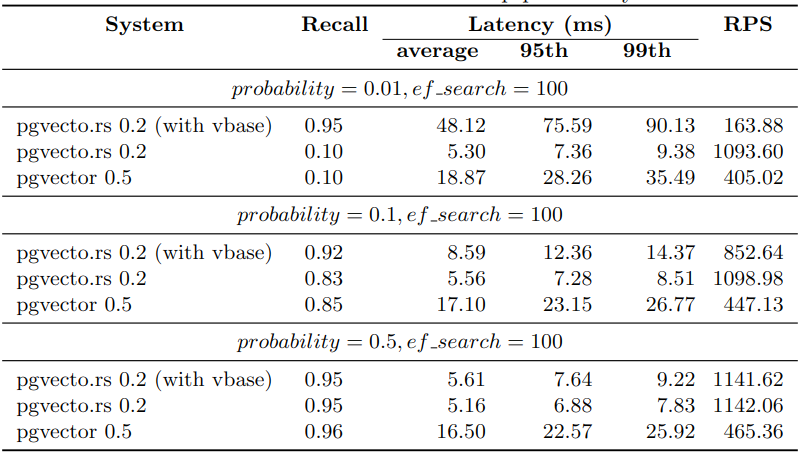
We present the recall, latency (in milliseconds), and RPS (requests per second) for various probability ranges while keeping the ef_search constant. The ef_search parameter represents the size of the list utilized during k-NN (k-Nearest Neighbors) searches, determining the trade-off between search accuracy and query processing time.
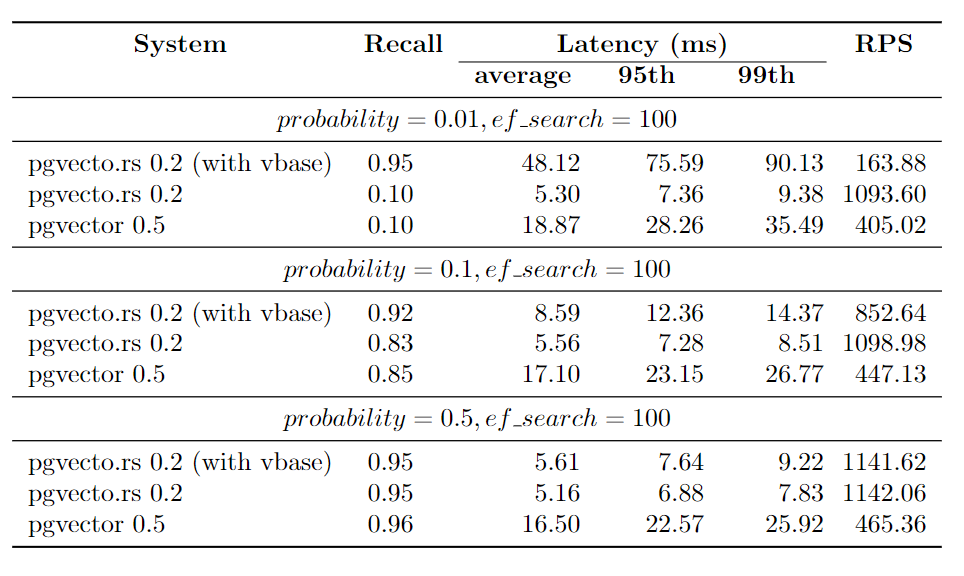
pgvecto.rs, when used with VBASE, consistently yields improved recall, particularly when working with low probability values.
Sparse Vector Search
Sparse vectors are high-dimensional vectors that contain few non-zero values. They are suitable for traditional information retrieval use cases. For example, a vector with 32,000 dimensions but only 2 non-zero elements is a typical sparse vector.
Dense vectors are embeddings from neural networks. They are generated by text embedding models and have most or all elements non-zero. They have fewer dimensions, such as 256 or 1536, much less than sparse vectors.
pgvecto.rs supports both dense vector search and sparse vector search. It provides the ability to use the svector data type to build sparse vector indexes and perform searches on them.
Vector dimensions
The pgvecto.rs extension provides support for up to 65535 dimensions, whereas the pgvector extension supports a maximum of 2000 dimensions. This difference in dimensionality support allows pgvecto.rs to handle vectors from OpenAI’s latest embedding model directly.
Single Instruction/Multiple Data (SIMD)
pgvecto.rs utilizes the SIMD (Single Instruction, Multiple Data) instructions available on the user’s machine, pgvector relies on the compiler to generate SIMD code at compile time and cannot choose a faster instruction set at runtime. It makes search in pgvecto.rs faster due to the faster calculation of vector distances.
Data Types
Binary Vector
The bvector type is a binary vector type in pgvecto.rs. It represents a binary vector, which is a vector where each component can take on two possible values, typically 0 and 1.
Binary vectors offer significant advantages in specific embedding models like the OpenAI embedding model by effectively reducing memory usage while preserving a satisfactory level of accuracy.
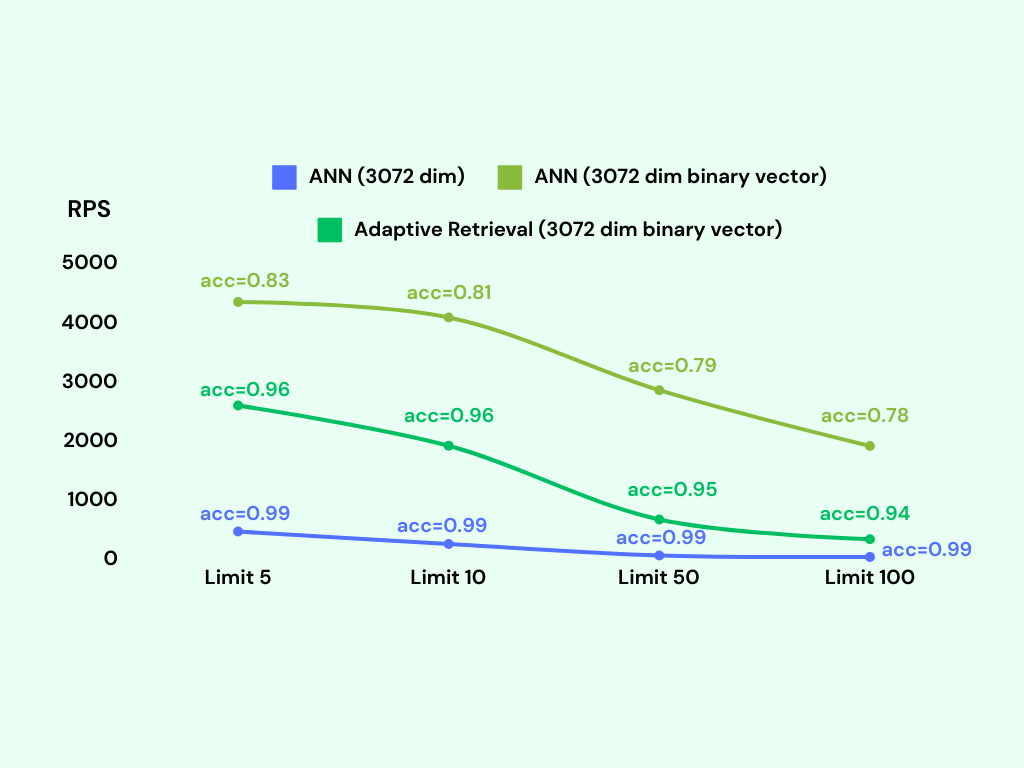
Here are some performance benchmarks for the bvector type. We use the dbpedia-entities-openai3-text-embedding-3-large-3072-1M dataset for the benchmark. The VM is n2-standard-8 (8 vCPUs, 32 GB memory) on Google Cloud.
We upsert 1M binary vectors into the table and then run a KNN query for each embedding. It only takes about 600MB memory to index 1M binary vectors, while the vector type takes about 18GB memory to index the same number of vectors. The bvector’s accuracy exceeds 95% if we adopt adaptive retrieval.
FP16/INT8
Besides binary vectors, pgvecto.rs also provides support for FP16 (16-bit floating point) and INT8 (8-bit integer) data types.
Indexing
pgvecto.rs takes a different approach compared to pgvector. It handles the storage and memory of indexes separately from PostgreSQL, instead of relying on the native storage engine of PostgreSQL like pgvector does.
It’s a design tradeoff. During the initial stages of our development, we conducted experiments with PostgreSQL’s page storage for the Hierarchical Navigable Small World (HNSW) index. similar to pgvector. However, we encountered various limitations that hindered its effectiveness and functionality:
- Parallelization Challenges: The process model of PostgreSQL, where each statement corresponds to a single process and the lack of thread-safe APIs, presents challenges for parallelization. In the case of building vector indexes, which involve computationally intensive tasks, parallelization can significantly enhance performance. However, our efforts to parallelize this process were impeded by frequent occurrences of ‘Too many shared buffer locked’ errors.
- Write-Ahead Logging (WAL) Amplification: The issue of Write-Ahead Logging (WAL) amplification arises when inserting a 2KB vector results in generating over 20KB of WAL. This problem is inherent in the HNSW algorithm used, as it involves modifying multiple edges for a single point insertion. PostgreSQL records each change individually in the WAL, leading to substantial amplification of the WAL size.
- Lock Contention: Lock contention arises due to the need to lock every edge list during reads and writes when traversing the HNSW graph. The hierarchical structure of HNSW, where higher levels contain fewer points, often results in lock contention becoming a common bottleneck during index usage. This contention occurs when multiple operations attempt to access or modify the same edge list simultaneously, leading to delays and reduced concurrency.
pgvecto.rs adopted a design akin to FreshDiskANN, resembling the Log-Structured Merge (LSM) tree concept. This architecture comprises three components: the writing segment, the growing segment, and the sealed segment. New vectors are initially written to the writing segment. A background process then asynchronously transforms them into the immutable growing segment. Subsequently, the growing segment undergoes a merge with the sealed segment, akin to the compaction process in an LSM tree. This design offers several benefits:
- Non-blocking Insertions: Index modification operations do not impede insertion processes.
- Batched Modifications: Grouping modifications to the HNSW graph improves throughput.
- Elimination of Read-Write Lock Contention: Since sealed segments are immutable, issues related to read-write lock contention are mitigated.
However, there are drawbacks to this approach. One notable limitation is the absence of out-of-the-box Write-Ahead Logging (WAL) support for the index. This means that features like Point-in-Time Recovery and Physical Replication, which rely on WAL, are not readily available for the index. Nevertheless, the PostgreSQL ecosystem is robust and allows for extensions to define their own custom WAL through a resource manager. While implementing this solution requires additional effort, it is feasible to overcome the limitation and enable WAL support for the index.
Summary
Here we will show the main distinctions between pgvecto.rs and pgvector.
| Feature | pgvecto.rs | pgvector |
|---|---|---|
| Filtering | Introduces VBASE method for vector search and relational query (e.g. Single-Vector TopK + Filter + Join). | When filters are applied, the results may be incomplete. For example, if you originally intended to limit the results to 10, you might end up with only 5 results with filters. |
| Vector Dimensions | Supports up to 65535 dimensions. | Supports up to 2000 dimensions. |
| SIMD | SIMD instructions are dynamically dispatched at runtime to maximize performance based on the capabilities of the specific machine. | Relies on compiler-generated SIMD code at compile time. |
| Data Types | Introduces additional data types: binary vectors, FP16 (16-bit floating point), and INT8 (8-bit integer). | - |
| Indexing | Handles the storage and memory of indexes separately from PostgreSQL | Relies on the native storage engine of PostgreSQL |
| WAL Support | Provides Write-Ahead Logging (WAL) support for data, index support is working in progress. | Provides Write-Ahead Logging (WAL) support for index and data. |
3 - Why not a specialty vector database?
Read our complete blog at Do we really need a specialized vector database? (2023) | vchord.pgsty.com.
Imagine this, your existing data is stored in a Postgres database, and you want to use a vector database to do some vector similarity search. You have to move your data from Postgres to the vector database, and you have to maintain two databases at the same time. This is not a good idea.
Why not just use Postgres to do the vector similarity search? This is the reason why we build pgvecto.rs. The user journey is like this:
From SingleStore DB Blog:
Vectors and vector search are a data type and query processing approach, not a foundation for a new way of processing data. Using a specialty vector database (SVDB) will lead to the usual problems we see (and solve) again and again with our customers who use multiple specialty systems: redundant data, excessive data movement, lack of agreement on data values among distributed components, extra labor expense for specialized skills, extra licensing costs, limited query language power, programmability and extensibility, limited tool integration, and poor data integrity and availability compared with a true DBMS.
4 - Benchmarks
pgvecto.rs has been focused on performance from the beginning. We have continuously monitored the performance of pgvecto.rs and compared it with other vector search libraries. The following benchmark results are from January 2024.
The test is done on Google Cloud n2-standard-8 (8 vCPUs, 32 GB RAM) with the laion-768-5m-ip dataset.
pgvecto.rs v.s. pgvector
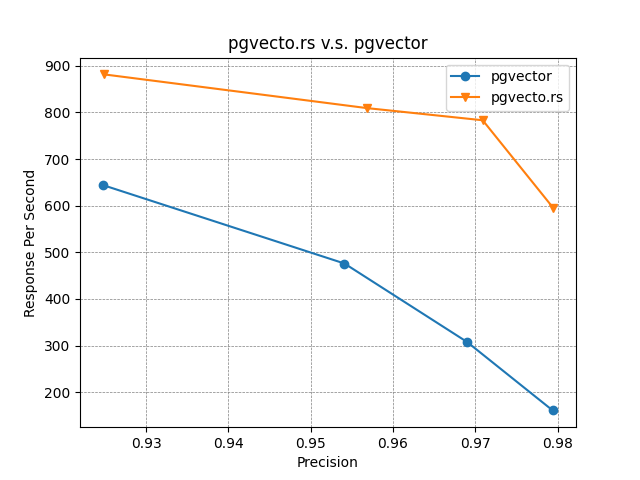
With the HNSW index, pgvecto.rs can achieve 2.5x responses per second as pgvector can do with a slightly better precision of around 97%. This advantage increases when higher precision is required.
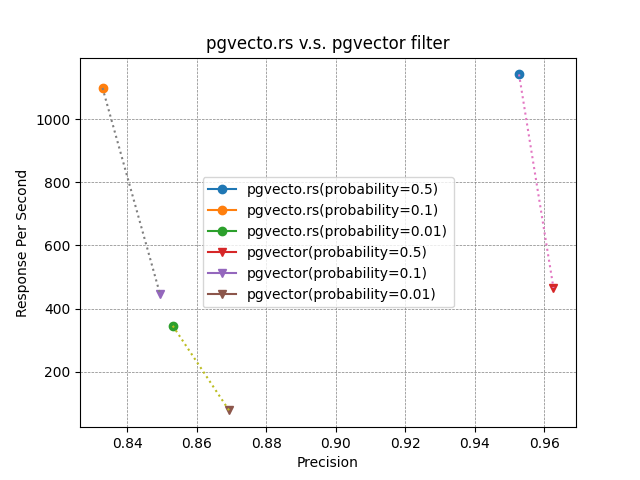
When the vbase mode is enabled, pgvecto.rs can achieve over 2x more responses per second compared to pgvector on various filter probabilities.
Different quantization methods
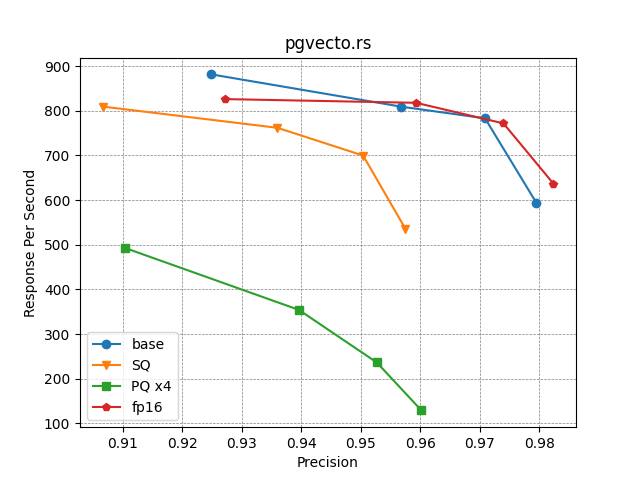
pgvecto.rs supports several quantization methods and different low precision indexing. These methods can help to reduce memory usage at different scales. The following figure shows the performance of pgvecto.rs with different quantization methods.
Shortening embeddings (a.k.a Matryoshka Embedding)
OpenAI latest embedding models support shortening embeddings, where developers could simply “remove some numbers from the end of a sequence” and still maintain a valid representation for text.
This enables very flexible usage. For example, when using a vector data store that only supports embeddings up to 1024 dimensions long, developers can now still use our best embedding model text-embedding-3-large and specify a value of 1024 for the dimensions API parameter, which will shorten the embedding down from 3072 dimensions, trading off some accuracy in exchange for the smaller vector size.
These are the performance benchmarks for the shortened embeddings. The dbpedia-entities-openai3-text-embedding-3-large-3072-1M dataset is used for the benchmark. The original embeddings have 3072 dimensions, while the shortened embeddings have dimensions of 256 and 1024. The benchmark was conducted using a VM with specifications of n2-standard-8 (8 vCPUs, 32 GB memory) on Google Cloud.
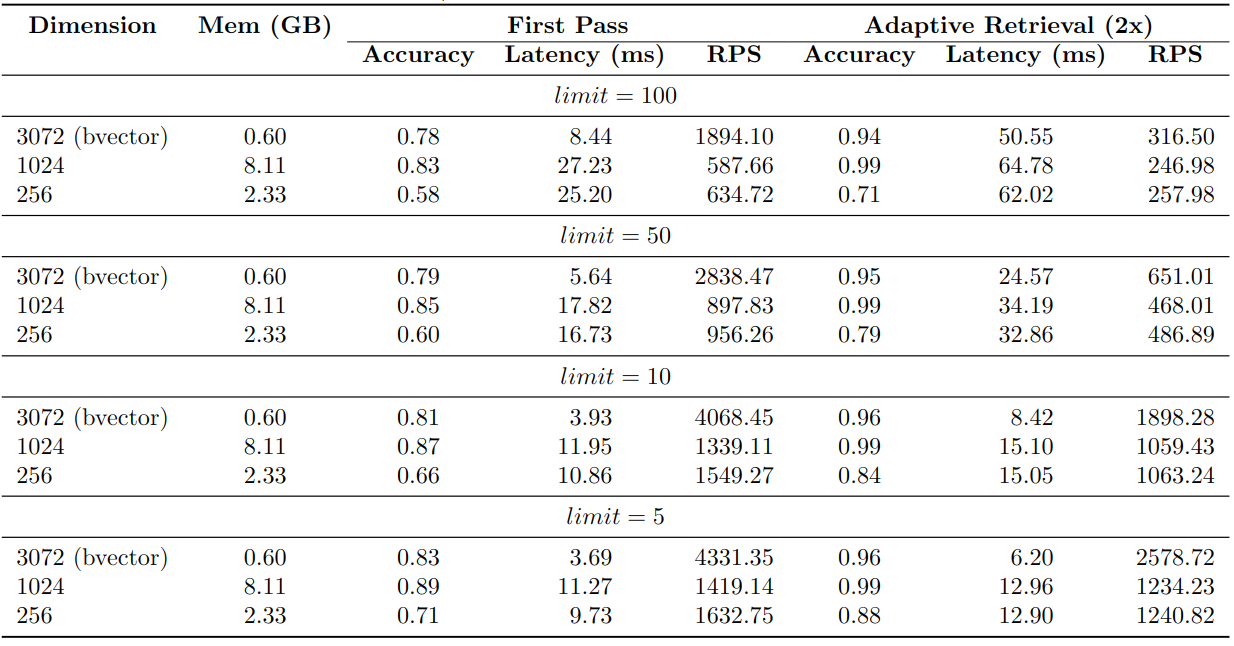
First Pass in the benchmark shows that the accuracy of the shortened embeddings is not as good as the full embeddings. 256D HNSW index only achieves ~65% accuracy, while 1024D HNSW index achieves ~85% accuracy.
However, the accuracy of the shortened embeddings surpasses 95% when adaptive retrieval is employed. Additionally, adopting this approach leads to significant improvements in terms of RPS (Requests Per Second) and latency.
Binary vectors
pgvecto.rs supports binary vectors. The bvector type is optimized for storage and performance. It uses a bit-packed representation to store the binary vector. The distance calculation is also optimized for binary vectors.
Here are some performance benchmarks for the bvector type. We use the dbpedia-entities-openai3-text-embedding-3-large-3072-1M dataset for the benchmark. The VM is n2-standard-8 (8 vCPUs, 32 GB memory) on Google Cloud.
We upsert 1M binary vectors into the table and then run a KNN query for each embedding. It only takes about 600MB memory to index 1M binary vectors, while the vector type takes about 18GB memory to index the same number of vectors.
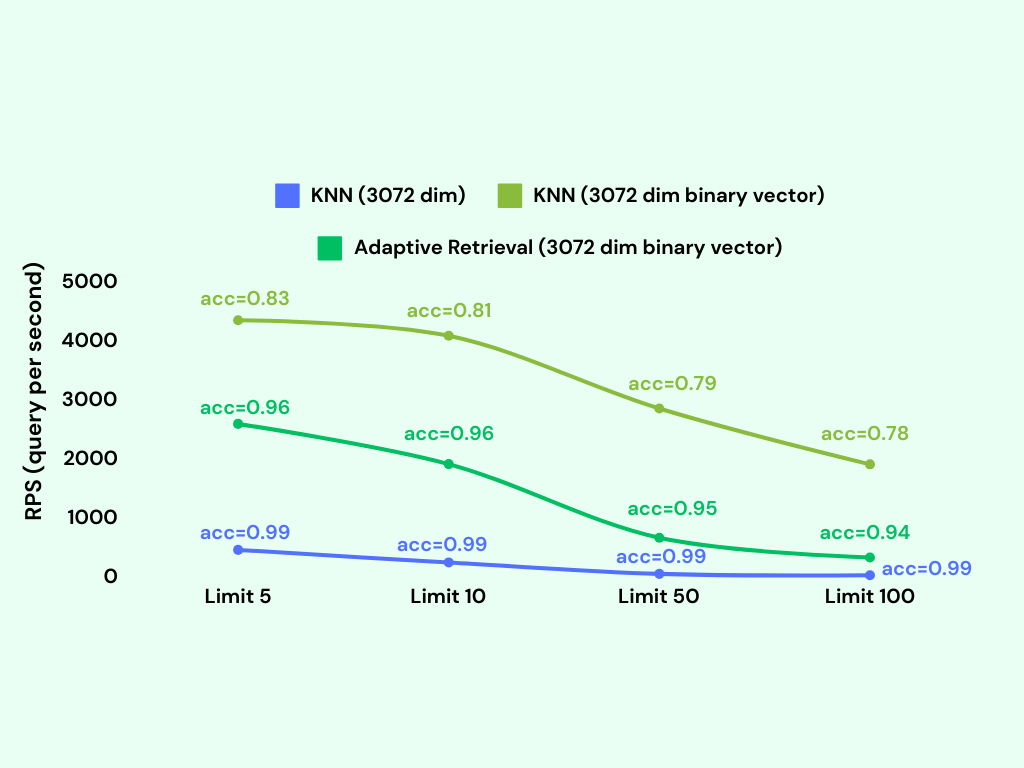
We can see that the bvector’s accuracy is not as good as the vector type, but it exceeds 95% if we adopt adaptive retrieval.